
The Antidote
Exhibition Archive
A4 Art Museum, Chengdu
18 April-7 June 2026
Copper, Nature & Technological Symbiosis
The Antidote brings together multiple strands of Daishi Luo’s long-term artistic research within a single spatial environment. Material transformation, cultivated colour, time-based processes, technological systems and experimental growth unfold across the museum as interconnected conditions rather than separate works. Copper appears simultaneously as infrastructure, archive and reactive medium, linking industrial systems to ecological and bodily processes. Rather than proposing a fixed answer, the exhibition operates as a temporary research environment—part laboratory, part archive, part landscape—in which cultivation, transformation and interaction remain active. Moving through the space, viewers repeatedly return to an unresolved question: What is next? CURATORIAL TEXT Yuting Yang, curator of A4 Art Museum The exhibition showcases Daishi Luo’s long-term interdisciplinary research and artistic practice centered on copper. Marking her first solo exhibition in a museum, The Antidote brings together ten bodies of work that respond to the conditions of the present: amid continuous technological advancement and ongoing social transformation, how can individuals re-examine their relationship with nature and technology under uncertainty, and explore possible mechanisms of synergy and balance among them? Copper, as a material that runs through human civilization, technological development, and the natural world, functions not only as a key component in infrastructure but also carries cultural and ecological attributes. Luo transforms it into a medium that connects nature, technology, and society. For much of modern history, technology has been understood as a tool for controlling nature. From the Industrial Revolution to the digital age, human beings have extended their capacity to intervene in the world through machines, materials, and systems. Yet as ecological crisis, artificial intelligence, and biotechnology accelerate simultaneously, the limits of this one-directional logic of control become increasingly apparent. Technology is no longer merely an instrument of human will, and nature can no longer be treated as a passive resource. What emerges instead is a field of complex relations shaped by interdependence, feedback, and uncertainty. It is within this context that The Antidote adopts healing as a clinical metaphor. Rather than proposing a final solution, the exhibition asks what kind of material foundations “progress” is built upon, and what forms of exhaustion, imbalance, and anxiety accompany technological expansion. Copper, the exhibition’s foundational material, runs through human civilization, technological development, and the natural world. It is both a crucial component of infrastructure and a material that changes with time: it oxidises, discolours, and reacts, continuously recording environmental conditions and material shifts. Since 2015, Daishi Luo has developed a long-term practice around copper through field research, material experimentation, and interdisciplinary investigation. Beginning with her study of copper’s chromatic transformations in industrial design and jewellery, she later travelled to traditional craft workshops in places such as Luoyang, Baoji, Suzhou, and Tongling, tracing vernacular knowledge of how copper can be transformed through local materials and natural agents. These investigations led her to understand copper not as a fixed object, but as a living medium capable of collaborating with natural forces. Over time, Luo developed a working method that brings copper into contact with plant extracts, mineral reactions, seawater, soil, weaving, ceramics, and other craft-based techniques. Drawing from Chinese medicine, material science, chemistry, and biology, she has built a growing archive of copper colour cultivation systems. Since 2018, she has systematically documented these experiments through what she calls “controlled out-of-controlness”: a process in which precise conditions are maintained while the irreproducible elements of time, temperature, humidity, and environmental response are deliberately preserved. To date, this system has generated 528 colour and texture variations, forming the basis of her evolving material language. Within this framework, industrial copper waste is no longer treated simply as a resource to be consumed or discarded. Instead, it re-enters cycles of transformation through the participation of nature and time, producing new colours, crystals, and structures. From colour-skin to crystal-skeleton, Luo’s practice explores how matter can grow across the threshold between surface and structure, image and object, control and emergence. Craft, in this context, is not decorative; it restores human scale to the laboratory and allows nature, people, and technology to function within the same collaborative network. The exhibition unfolds across six spatial chapters and ten new bodies of work. At the entrance, The Network Gate turns copper shielding mesh into a passable threshold. What is next? expands into a ten-metre-long sculptural question about extraction and future possibility. Transformer Lab becomes an active cultivation site where copper, plants, minerals, seawater, and soil generate coloured forms over time. Copper Color Gene Bank systematises these outcomes into an evolving archive of chromatic knowledge. SEED compresses the temporal logic of growth into visible rhythm, while Super Composite Being reanimates technological waste into new hybrid life forms. Mirror of Time-Space, Connection, and Searching for the Antidote return the viewer to the body and to the question of how relations might be rebuilt between human beings, materials, and the systems they inhabit. Ultimately, The Antidote does not seek to establish a new regime of control. Instead, it proposes another possibility: that within increasingly complex systems, human beings may no longer be masters, but participants, mediators, and collaborators. What is being sought is not a final answer, but a new relational structure connecting human beings, nature, technology, and the future.
Installation Views


3F | A4 Art Museum


THRESHOLD
THE NETWORK GATE, 2026
Material: Copper shielding mesh
Dimensions: 220 X 250 cm
THE NETWORK GATE
Copper shielding mesh—normally used to block signals and isolate electromagnetic interference—is torn open into a traversable threshold. A material designed for protection and separation becomes an invitation to enter the exhibition’s network of relations.


QUESTION: WHAT IS NEXT?
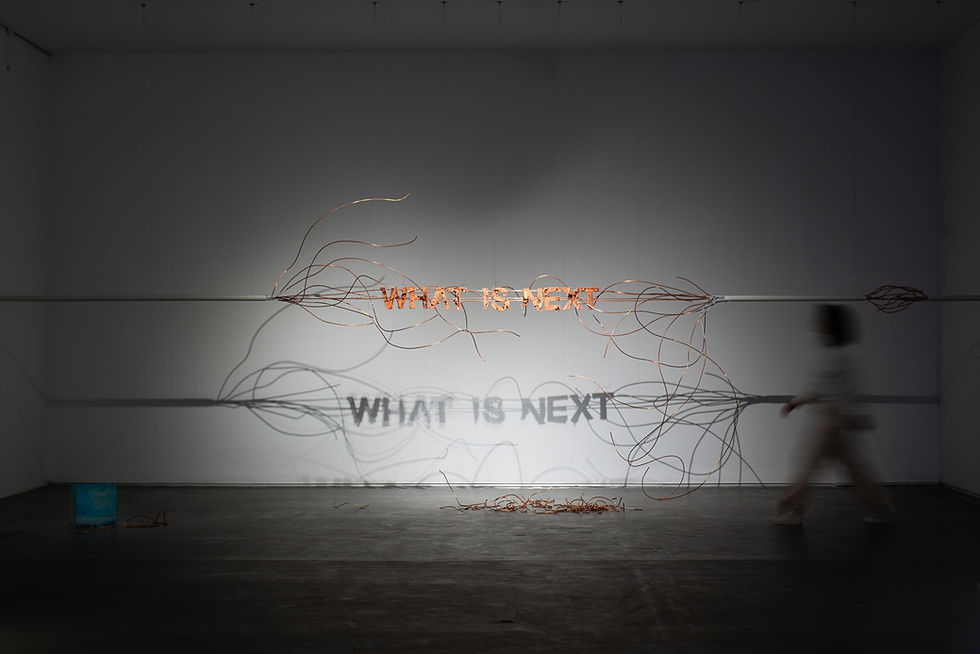
WHAT IS NEXT, 2026
Material: Discarded copper wires, copper pipes, guided-growth crystals, cultivation tank, PVC pipes
Dimensions: 865 × 180 × 105 cm


WHAT IS NEXT
A ten-metre sculptural question introduces the exhibition without offering a conclusion, linking industrial copper infrastructure with guided crystalline growth.
CULTIVATION

Transformer Lab, 2026
Material: Industrial copper plates, discarded wires, various plants, minerals, soil, seawater, laboratory glassware, petri dishes, lenses, stainless steel with white spray paint
Dimensions: Approx. 550 L × 480 W × 420 H cm
TRANSFORMER LAB
The centre of the exhibition operates as an active cultivation site. Copper plates, plants, minerals, seawater, soil and time are brought into designed conditions in which colour and crystalline structures continue to form throughout the exhibition.


ARCHIVE
COPPER COLORS 2016-ongoing
Material: Industrial copper plates, brass plates, various natural reactive materials, oxides, guided-growth colors, petri dishes, book
Dimensions: Variable installation
COPPERCOLORS
Ten years of material research enter the museum as an evolving archive. Samples, methods, field records and the Copper Color Gene Bank make a long-term process of experimentation visible within the exhibition space.


TIME

Video excerpt_SEED II, 2016-Ongoing
Single-channel color video with sound, 1'33"
SEED II
Time-lapse observation compresses an almost imperceptible process of material growth into a visible rhythm.

COMPOSITE SYSTEMS

Super Composite Being, 2026
Material: Discarded wires , leaves, shells, guided-growth sculpture, copper sulfate solution, glass culture tubes, light, cork stoppers
Dimensions: 10×10×100cm, ×3 pieces
Discarded technological materials, ceramics, organic matter and cultivated crystalline structures form a group of works in which existing systems are reorganised into new relations.
SUPER COMPOSITE BEING
Discarded data cables, shells and leaves are brought into the same cultivated system, where technological waste and organic matter begin to alter one another.


MIRROR OF TIME-SPACE
Mirror of Time-Space, 2026
Material: copper shielding mesh, guided-growth crystals, stainless steel
Dimensions: 45×25×100cm
MIRROR OF TIME-SPACE
A crystalline mirror reflects and disrupts the viewer’s image, positioning the body within the exhibition’s system of growth and change.


CONNECTION
CONNECTION
Ceramics and copper wires recovered from discarded data cables are reconnected through guided growth, forming a new network between craft, technological infrastructure and material transformation.
Connection, 2026
Material: copper wires from discarded data cables, ceramics, copper pipes, guided-growth crystals
Dimensions: Variable dimensions


BODY: SEARCHING FOR THE ANTIDOTE

Searching for the Antidote, 2026
Material: video, guided-growth sculptures, cables, glass
Dimensions: 900 x 900 x 900 cm
SEARCHING FOR THE ANTIDOTE
Video, discarded cables and a guided-growth sculpture bring the exhibition’s technological and ecological systems back to the human body. The work moves between entanglement, pressure and an unresolved gesture of reaching outward—toward another possible relation still in formation.


Video excerpt_Searching for the Antidote, 2026
Single-channel color video with sound, 26:32


RETURN TO THE QUESTION: WHAT IS NEXT ?

WHAT IS NEXT?, 2026
Material: Discarded copper wires, copper pipes, guided-growth crystals, cultivation tank, PVC pipes
Dimensions: 865×180×105 cm
The exhibition ends where it began: with a question.
After moving through cultivation, transformation, archive, composite systems and the human body, the viewer returns not to a conclusion, but to something unresolved.


Add paragraph text. Click “Edit Text” to update the font, size and more. To change and reuse text themes, go to Site Styles.
Credits
A4 Art Museum
Acknowledgements
Production Support: Tan Zhipeng, Studio MánMán
Video Production: Tian Tu Photoqraphy Studio
TV Support: Banmu Fangzhai Home Furnishing Full-Solution Center
Special Thanks to: Tan Zhipeng, Duan Shengfeng, Camille Gasser, Matthieu Pajot, Lisa Gisselbrecht, Thomas Oliver Pryce, Li Xin, Guo Hailong, Chen Cai, A Min, Liu Limei
Exhibition Team
Curator: Yang Yuting
Exhibition Coordinator: Yang Yuting
Visual Design: He Yanming, You Yi(Intern)
Brand Promotion: Zhang Haoyue, Zhou Yijia, Ruan Feng
Operations Support: Yang Siying, Zhao Zijun, Ye Zimeng, Li Shiqi
Exhibition Support: Geng Mengze, Tang Wanke (Intern)
Exhibition Construction: Chengdu Tuoyue Culture Communication Co., Ltd.
Security and Sanitation: Jiang Zhibo, Wang Hongyu, Chen Nan, Liu Huaying, Shu Decheng, Yuan Xiaohong, Huang Yueqiu, Song Shiqiong, Ye Huirong
About A4 Art Museum