COPPERCOLORS

A living research platform
2016 - Ongoing
Supported by the National Arts Fund of China and the Shenzhen Creative Foundation
How does material knowledge emerge from relationships between matter, environment, technique and human intervention?

FROM COLOUR TO KNOWLEDGE
COPPERCOLORS began as an investigation into how colour and surface emerge through interactions among material, environment, time and human intervention.
Rather than treating colour as a fixed visual property, I approach it as an emergent phenomenon. Different materials, conditions, techniques and durations generate different traces of transformation.
Over time, what began as material experimentation developed into an open research platform combining experimentation, fieldwork, documentation and classification.


172 Workshops & Craft Sites
429 Knowledge Holders
LEARNING FROM THE FIELD
Before entering the studio, the research entered the field.
Over nearly a decade, I travelled across different regions of China to observe how material knowledge develops through long-term relationships among local environments, resources, techniques and generations of practice.
Soil, water, fire, plants, minerals, bamboo, silk, metals and paper are understood not in isolation, but through repeated observation, adaptation and embodied experience.
These encounters revealed that making is rarely the result of a single material or individual. It emerges from relationships among environment, technique and accumulated knowledge.


EXPERIMENTAL CULTIVATION
Knowledge gathered through fieldwork entered the studio alongside chemistry, biology, electrochemistry, plant dyeing, mineral reactions and environmental observation.
Rather than treating copper as a passive surface, I began using it as an experimental ground in which colour could be cultivated through time.
Plant extracts, minerals, medicinal ingredients, seawater and other reactive substances are introduced under carefully designed conditions, while temperature, humidity, light, electricity and duration remain active variables.

OUT OF CONTROL WITHIN CONTROL
Thousands of experiments
Through thousands of experiments—including failures, unexpected reactions and prolonged observation—a working methodology gradually emerged.
I establish conditions and parameters, while allowing material behaviour, environment and time to participate in the process.
What cannot be fully predicted becomes information for the next experiment.


527 CULTIVATED COLOURS / 10 YEARS
FROM MATERIAL EXPERIMENT TO KNOWLEDGE SYSTEM
Over years of continuous experimentation, individual experiments accumulated into a system rather than a collection of isolated results.
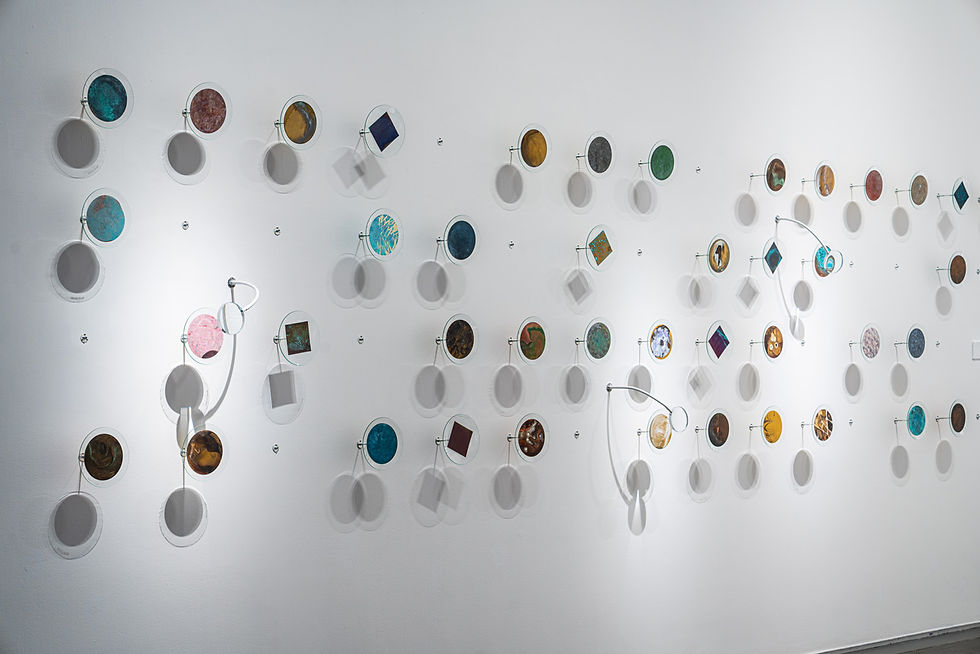
The Copper Color Gene Bank currently contains 527 cultivated colours, each documenting a repeatable relationship among material, environmental conditions, method and time.
Rather than functioning as fixed swatches, these entries can be revisited, modified and recombined, allowing previous experiments to become starting points for new ones.

THE COPPER COLOR GENE BANK
Each colour is both a record of a previous relationship and a starting point for the next experiment.
4 RESEARCH FAMILIES
SOURCE
Intrinsic behaviours of copper.
HERITAGE
Material knowledge encountered through field research.
GENERATED
New colour systems developed through interdisciplinary experimentation.
ECOLOGICAL
Long-term interaction between human intervention and environmental processes.


TIME AS MATERIAL
How can time make transformation observable?
SELECTED WORKS

SEED II
10,000+ observations / time-lapse

METAMORPHOSIS
72 hours / environmental variables

TRANSFORMER LAB
40 days / real-time transformation
NEXT QUESTION
If material relationships can generate new forms, what emerges when bodies, technologies, living systems and environments enter into sustained interaction?
